
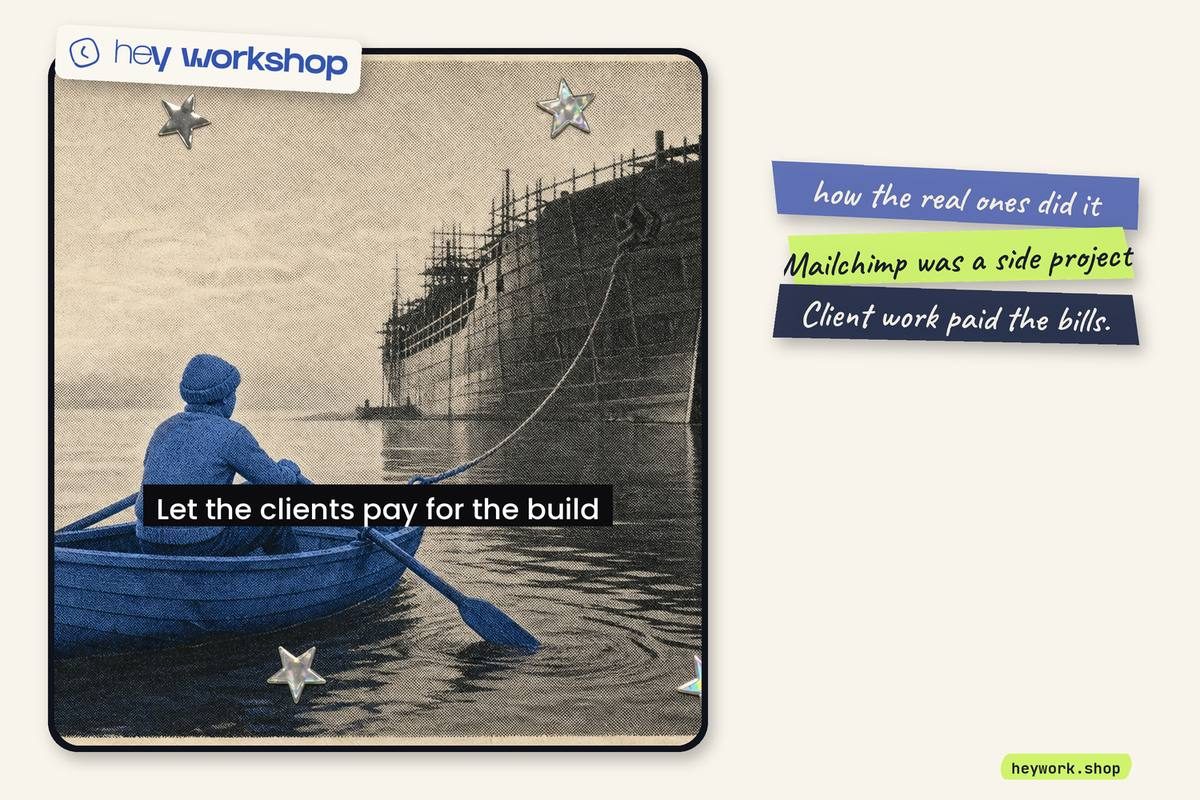
Let the clients pay for the build
Mailchimp was a side project for years and the agency work paid the bills. That is the unglamorous way in, and it is the one where you keep the whole thing.
In 2000, two guys got laid off. They started a small web design agency in Atlanta called the Rocket Science Group, because design was the skill they had and clients would pay for it.
Their clients kept asking the same question. How do we email our customers?
The agency did not offer that. So Ben Chestnut dug up some code left over from a greeting card business that had not worked out, and they built a little email tool on the side.
They kept the agency running for years. The agency paid the bills. The side project got the leftover hours.
That side project was Mailchimp. They never took a dollar of outside money, they owned the whole thing, and in 2021 Intuit bought it for 12 billion dollars.
Here is the part people skip when they tell that story.
It is not a story about quitting on a Tuesday and betting everything. It is a story about getting paid by clients, and letting that money buy the time to build.
Client work is not the detour. Client work is the funding.
You are waiting for the wrong thing
If you are sitting on an idea and waiting until you can afford to start it, you are waiting for money to arrive from somewhere. An investor. A loan. A miracle quarter.
You do not need any of those. You need one or two people who will pay you for a skill you already have. That is your funding round, and nobody takes a piece of your business for it.
There is a second thing hiding in the Mailchimp story, and it is worth more than the money.
The clients wrote the product brief. “How do we email our customers” was the whole spec. Ben and Dan never had to guess what people wanted, because people were already asking them out loud, with a credit card in hand.
Client work pays you to do market research. Most people pay for that in savings and in lost years.
The same shape keeps showing up
I went looking to see whether this was just one lucky story from 2001. It is not. Some of the clearest writing on it is happening on Substack right now.
Durva Mathure interviewed Jen Yip, who has run the budgeting app Lunch Money solo for seven years, for her series Table For One. Read how Lunch Money started. Jen was freelancing for three different companies as a software engineer, living out of a suitcase, and she built the thing on the side because she missed coding for fun. The freelance income and her savings funded years of quiet, unglamorous building. She has still never taken a cent of outside money.
Melissa Kwan bootstrapped eWebinar to 5 million in annual recurring revenue and writes about it every week in your founder next door. She told the story of Userflow this week. Two people and a part-time designer, no investors, sold for a reported 60 million. Her lesson is the one that matters here. They paid themselves properly the whole way, so they were never in survival mode, and people who are not in survival mode make better decisions.
That is what client money buys you. Not luxury. Calm.
And this week, in founderdraft, Ishit Jethwa wrote one line about building his shoe brand without outside money that I have not been able to put down. “Not having money teaches you, very specifically, where to spend it.”
The honest part
You are not going to sell to Intuit. Neither am I. That is not why the story is useful.
The story is useful because it takes the scariest version of starting off the table. You do not have to choose between your rent and your idea. That was never the real choice. The real choice is whether you are willing to build slowly, in the hours you have, funded by people who are already paying you.
It is less romantic. It is also the version that actually works for a person with bills.
What this looks like for you this week
Name the skill someone would pay you for today. Not the dream business. The skill you already have. Write it down.
Get one client. One. Not a pipeline, not a brand, one person who pays you.
Ring-fence the hours. Pick two evenings and defend them. That is the build.
Listen to what your clients keep asking for. That question, the one you keep hearing, is your product.
Ben and Dan ran an agency for years before Mailchimp was the main thing. Jen freelanced for three companies while she built Lunch Money. Nobody skipped the boring middle. They just got paid during it.
You do not need to be fearless. You need to be in motion.
What is the skill you would sell first? Reply and tell me. I read every one.
If this was useful, subscribe and I will send you the next one. And if you want the map for the whole thing, from a fuzzy idea to a paying business, it is at heywork.shop.
This piece credits Durva Mathure, Melissa Kwan, Ishit Jethwa. The links go to the original on our Substack, where you can follow them on through.
First published in the Hey Workshop newsletter. Read it on Substack or subscribe there.