
You don't have to build the thing to find out if anyone wants it
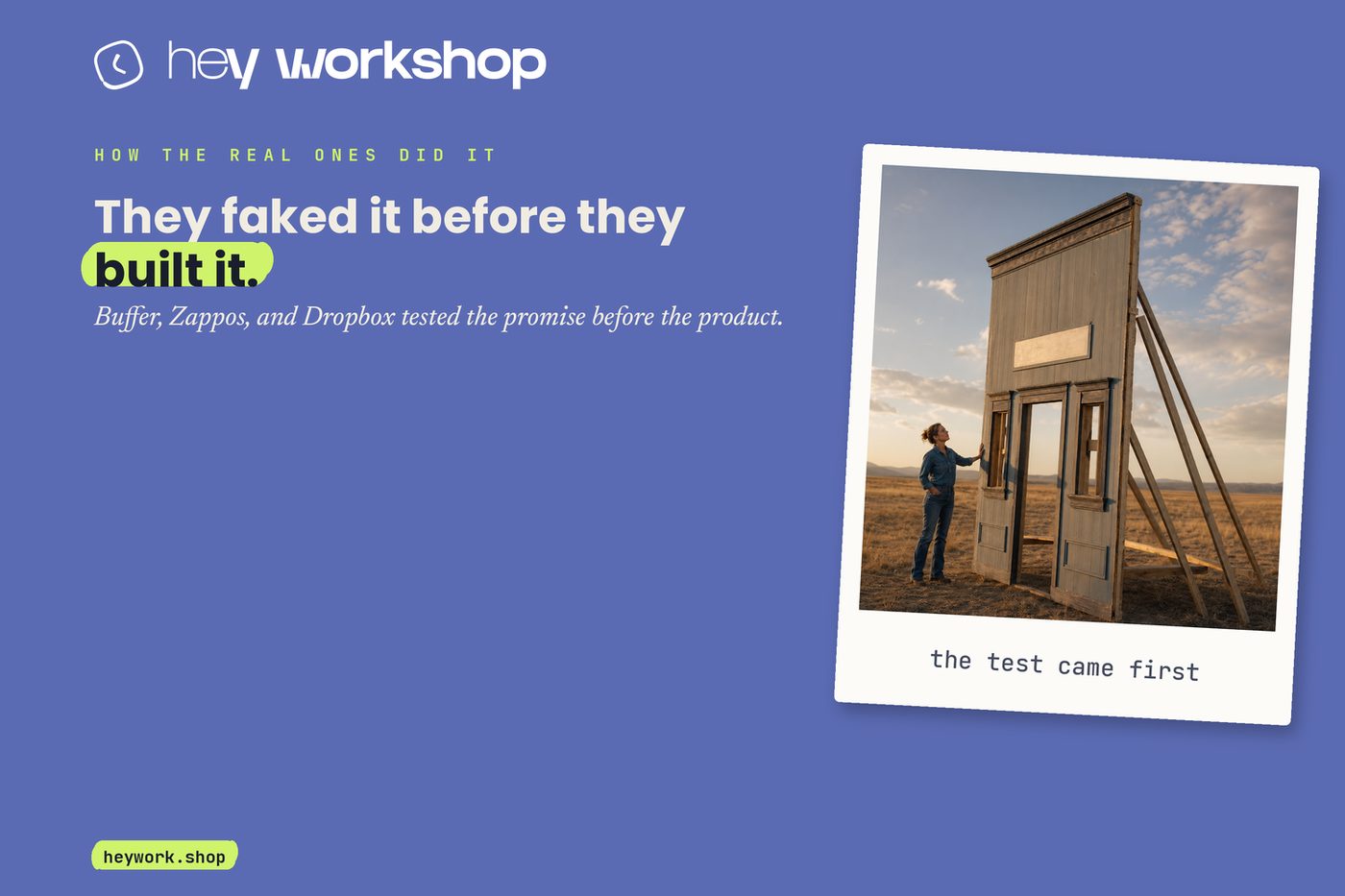
Before Dropbox, Zappos, and Buffer were real products, they were clever little fakes. Here is the tiny version of that move you can run this week.
There is a quiet story you tell yourself when you want to start something. It goes like this. Once the thing is built, once it looks real, once it is good enough that nobody will laugh, then you will show it to people. Then you will find out if it works.
So you wait. You sketch. You buy the domain. You tweak the logo at eleven at night. And the whole time, the one question that actually decides everything sits there unanswered. Does anyone even want this?
Here is the part nobody tells you. The companies you are quietly intimidated by did not answer that question by building the finished thing. They answered it with something small and a little bit fake, put in front of real people, on purpose, before the product existed. You are comparing your empty first day to their polished tenth year. It is not a fair fight, and it is not the real story.
Asking your friends is not the test
First, let me take away the fake version of validation, the one that feels like progress and teaches you nothing.
You describe your idea to a few friends. They say it sounds great. You feel a little braver. That is not evidence. Paul O’Brien, who has spent thirty years around startups and writes Startup Economist, puts it about as bluntly as it can be put. Asking people whether your idea is good, he says, is not validation. It is therapy. You are asking people with no stake in your success to make you feel better about a decision you already made, and “sounds interesting,” he writes, is the most useless signal in the history of entrepreneurship.
The thing that counts is not what someone says. It is what they do. Do they click. Do they leave an email. Do they hand you money. An idea is just a guess until someone pays you, and no amount of nodding at a coffee shop turns the guess into a fact.
So the real move is not to ask louder. It is to build the smallest possible thing that lets a real person say yes with an action, and then go watch what they actually do. Here is what that looked like for three companies you have definitely heard of.
Buffer was a page before it was a product
In 2010, Joel Gascoigne had an idea for an app that would space out your social posts. He did not build it. He built a page.
The page explained what the tool would do and had a button that said “Plans and Pricing.” When people clicked it, hoping to buy, they hit a second page that said, more or less, you caught us before we are ready, leave your email and we will let you know. That was the whole thing. No app behind it. Just a promise and a door.
He was not measuring compliments. He was measuring clicks. How many people wanted it enough to reach for their wallet, and how many of those cared enough to leave an email when they could not. Only once real strangers had done both did he sit down and build the actual product. The fake page was not dishonest. It was the cheapest possible way to ask a real question and get a real answer.
Your version costs nothing. One plain page, or even one clear message, that describes the thing and asks for a small real yes. You are not lying. You are finding out.
Zappos was a guy buying shoes at full price
Before Zappos was a billion dollar company, it was Nick Swinmurn walking into shoe stores in 1999.
He believed people would buy shoes online. Everyone told him they would not. So instead of raising money and building warehouses and buying inventory, he asked the store if he could photograph their shoes. He put the photos on a simple website. When someone actually ordered a pair, he drove back to the store, bought them at full retail price, and mailed them out himself.
He lost a little money on every sale, and he did it happily, because he was not trying to make money yet. He was buying the answer to one question. Will a real person, with a real credit card, buy shoes from a screen. Every order was a yes he could hold.
That is the trick most people skip. You do not need the machine. You do not need it to scale. You need one real sale to prove the thing is real, and you are allowed to do it by hand, ugly and unglamorous, while you find out.
Dropbox was a three minute video
Drew Houston had the opposite problem. His idea was genuinely hard to build, and easy to get wrong, and he did not want to spend a year building it only to learn nobody cared.
So before it really worked, he made a short screen recording that showed what it would feel like to use, files quietly syncing across computers like magic. He posted the video. Overnight, the waiting list went from around five thousand people to seventy five thousand. He had not built the finished product. He had shown the promise, clearly, and counted the raised hands. Seventy five thousand hands is not a focus group. It is a reason to go build.
You do not need seventy five thousand anything. You need to show one clear picture of the after, the result you are offering, and count who leans in.
The pattern is the permission
Look at the three of them together. A fake pricing page. A guy buying shoes retail. A video of a thing that barely worked. None of them started with the finished product. All of them started with a test that a real person could respond to with an action.
This is the exact opposite of how it feels like you are supposed to do it. It feels like you have to disappear, build the whole polished thing in secret, and emerge with it finished. That instinct is the trap. Carrie Loranger, who writes 9-to-Thrive, tells a story about a woman with a Google Doc of forty seven product ideas, color coded, ranked by a “viability score,” added to for nine months, and sold to exactly zero people. The doc was not preparation, Carrie writes. It was a hiding spot. Planning felt safe because a spreadsheet cannot reject you. The fix was not more research. It was to publish before she felt ready. You are not building the final product, Carrie says. You are building proof.
And proof is smaller than you think it needs to be. Wes Pearce, who writes Escape the Cubicle, made his first real money online from a simple guide he built in a single weekend, sold to a small audience, because it answered one question people kept asking him. You do not need ten thousand followers, he says. You need one real problem, one simple solution, and the willingness to ship it. The barrier was never the size of the thing. It was deciding to make it and put it out in the world.
The one small thing to do this week
You do not have to quit anything. You do not have to build anything big. This week, build your clever little fake.
Write one plain paragraph that describes the thing you want to make and the one problem it solves. Add one way for a real person to say yes with an action, not a compliment. A link that says “I want this.” A pre-order for a few dollars. A reply that says “put me on the list.” Then send it to a small handful of people who actually have the problem, and go quiet, and watch what they do.
If nobody moves, you just saved yourself the year. That is a win, not a failure. If a few of them move, you have something almost nobody starting out ever gets. Not a hope. Evidence. As Paul O’Brien puts it, you have not validated anything until someone outside your own head cares enough to sign up, pay, or even just respond.
The finished, famous version of every company you admire started as a small, slightly embarrassing test that a real person said yes to. Yours can too. You do not have to feel ready. You have to find out.
Hey. You can actually do this.
If you want the plain map and the do-the-work tools that take you from a fuzzy idea to a real, paying business, one honest step at a time, they live at heywork.shop. One-time, yours to keep, works in the sheets you already use.
What is the smallest test you could put in front of a real person this week? Tell me in the comments, I read every one. And if this is the kind of push you want in your inbox, subscribe and I will keep them coming.
P.S. Three writers whose thinking sharpened this piece, all worth a follow: Paul O’Brien at Startup Economist, Carrie Loranger at 9-to-Thrive, and Wes Pearce at Escape the Cubicle.
This piece credits Paul O’Brien, Carrie Loranger, Wes Pearce. The links go to the original on our Substack, where you can follow them on through.
First published in the Hey Workshop newsletter. Read it on Substack or subscribe there.