
How to niche down when narrowing feels like losing business
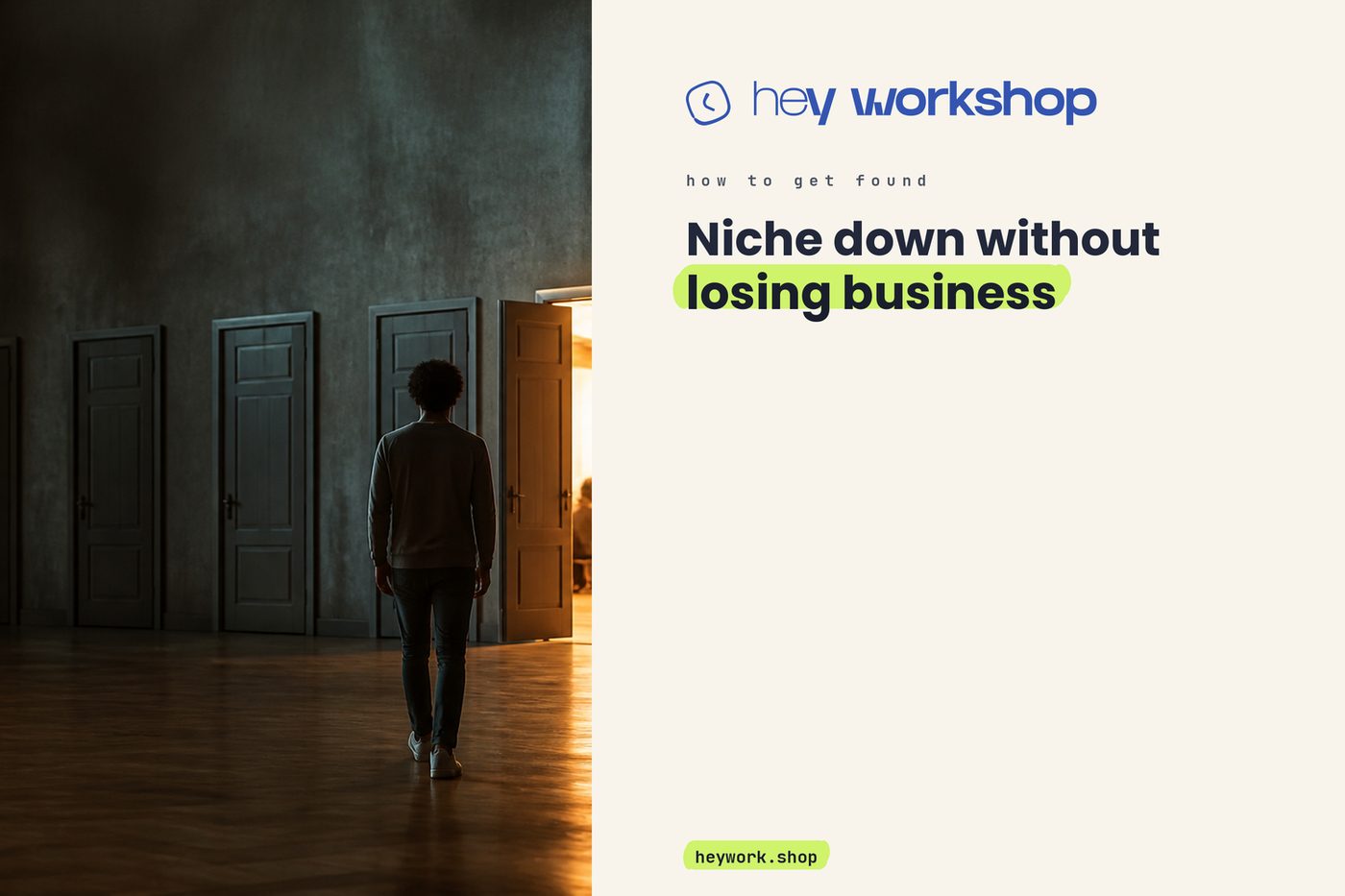
You are not closing doors. You are making it easy for the right person to know they found you.
You have a skill, maybe a few clients who already pay you, and everyone keeps saying the same word at you. Niche down. Niche down. Niche down.
And every time you try, it feels like shutting a door you might want to walk through later. So you keep your options open, you tell people you help “small businesses” or “anyone who needs a hand,” and then you wonder why the work still feels like pushing a boulder uphill.
I want to take the guilt out of this first. The resistance you feel is not a character flaw, and it is not you being uncommitted. Most of the time it is pointing at something real.
The fear is actually doing its job
Chiara Chimù Mulas, who writes Marketing for Good and coaches introverted business owners, said something I keep coming back to. She thinks the resistance to niching is not a lack of seriousness. It is that the advice “starts in the wrong place.” People sell niching as a cold business move: narrow your market, reject everyone else, raise the price. No wonder it feels like a cage.
Her reframe is the whole thing. Niching is not a wall to keep clients out. It is, in her words, the “elevator to the most specific communication your business can have,” so that when someone reads your words, they feel like you were talking to them and only them. A niche, she writes, is not a rigid prison. It is “a more fitting dress that makes you look great and appropriate to the occasion.” And when a client shows up who is just outside your niche but still a good fit, you serve them. Getting specific with your message never meant turning away good work.
That one move, from “who I turn away” to “who I speak to,” changes how the whole thing feels.
You are not niching yourself. You are niching the message.
Here is the part that trips people up. Niching down does not mean you shrink into a smaller, more boring person. It means one specific thing gets easy to say.
Think about a physiotherapist who decides to focus on runners. She still treats the occasional cyclist, the weekend hiker, the person who tweaked their back gardening. But because her whole message speaks to runners, runners find her, trust her fast, and show up already sold. The cyclist who wandered in came because her clarity made her look like someone who understands bodies that move. Specific did not make her smaller. It made her easy to recognize.
“If you serve everyone, you serve no one” is not dark magic. It is just how attention works. When you try to solve nineteen problems at once, none of them looks strong enough for a stranger to bet on. One clear problem, solved for one clear person, reads as “oh, this is my person.”
But do you actually have to?
Now let me be honest, because I do not think there is one right answer here.
Ben Walton, who writes A Life That Feels Like Yours, makes the opposite case, and he makes it well. He has built what he calls a portfolio career, several things that do not quite work alone but together do, and he pushes back on the pressure to flatten yourself into one lane. People are not one-dimensional, he says, and hiding the other parts of you can make you less memorable, not more. He has been freelance two years on that exact model, and the breadth is what feeds his bigger bets.
He is right, and it is worth holding both ideas at once. Being broad can be a real strategy, especially early, while you are still learning what you are good at and what actually lights you up. The mistake is not staying broad. The mistake is staying vague. You can be a whole, layered person and still have one sharp sentence that tells a stranger what you do for them.
So when do you actually narrow?
The CM Guide, the newsletter Kishi writes, has the clearest answer I have read on this. The honest version is: yes, eventually, and strategically, but not on day one.
In your first year, she says, be “a generalist with intention.” Take the different kinds of work. Notice where you keep doing your best. The right time to narrow is when you can choose “based on evidence rather than assumption,” when you can say, I have done this three different ways and I am clearly best at this one, for this person, on this problem. Niche too early and you are basically picking your career at fifteen. Niche from evidence and, as she puts it, “generalists compete on price, specialists compete on expertise.”
That is the honest timeline. You do not need to know your forever niche this week. You need to pay attention to the clues you are already collecting.
One small step for this week
If you want a single move, try this.
Write down the last three clients or projects that felt easy and good, the ones where the work flowed and you would happily do more of it. Then write the one sentence they have in common. Not your job title. The person plus the problem. “I help [this specific person] with [this specific problem].”
If that sentence makes the right person think “that is exactly me,” you have found the edge of your niche. If it still sounds like everyone, go one notch more specific and try it again.
You are not closing doors. You are hanging a clearer sign on the one you actually want people to walk through.
So what is the one sentence for your work right now, and does it sound like a specific person or like everyone? Tell me in the comments, I read every single one.
And if you want plain, no-hype tools for the clients side of your business, that is exactly the kind of thing we make over at heywork.shop. Free ones too.
If this helped, subscribe and I will keep sending the honest version, one step at a time.
This piece credits Chiara Chimù Mulas, Ben Walton, The CM Guide. The links go to the original on our Substack, where you can follow them on through.
First published in the Hey Workshop newsletter. Read it on Substack or subscribe there.