
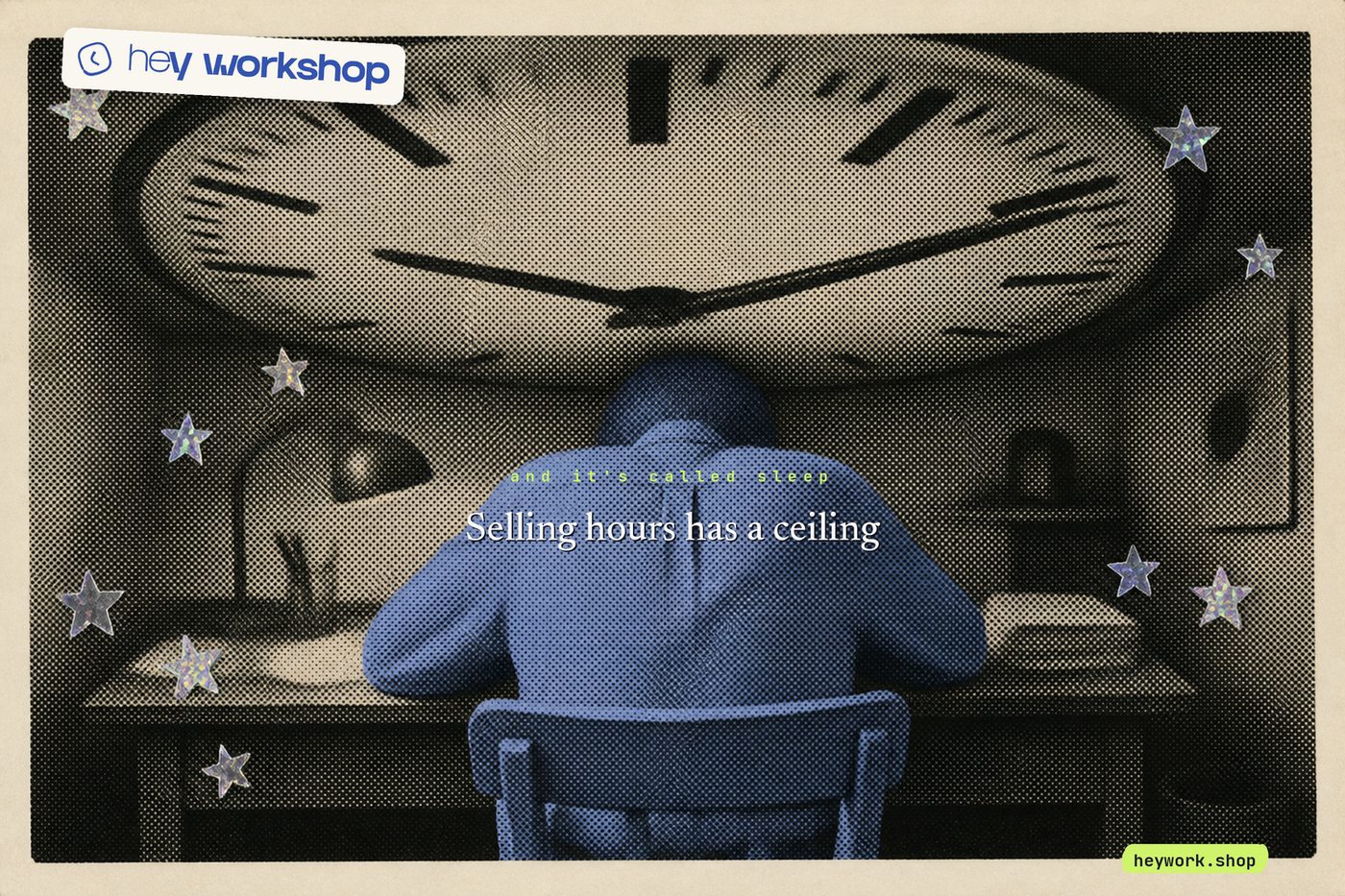
Selling hours means your income has a ceiling, and it is called sleep
Do the two minute math on your hourly rate, then look at what three people who left it behind actually charge instead.
Do this before you read anything else. It takes two minutes and it will make you a little uncomfortable, which is rather the point.
Write down the number of hours a week you actually want to work. Now subtract the hours it takes to run the business itself. The selling, the proposals, the invoicing, the follow ups, the emails nobody has ever paid you for. For most solo people that is 10 to 20 hours a week, gone before you have done a minute of client work. What is left is the only part you can sell.
Multiply that by your rate. Multiply that by 50 weeks.
That number is not your target. It is your ceiling. The only lever you have left is to sleep less.
Garrett Jestice calls this the fractional ceiling, and he ran the numbers on himself this morning. Three or four clients is the realistic maximum for most people working solo, and that already eats 30 to 40 hours a week. Add the 10 to 20 it takes to run the business and there is nothing left. His line is the one worth taping to your monitor: at that point, the only way to earn more is to work more, and you are already full.
Raising your rate helps. It should absolutely be the first thing you do. But it lifts the ceiling, it does not remove it, and every market has a cap on what it will pay for an hour of you, no matter how good you get.
The part that stings: hourly pricing punishes you for getting good
Here is the quiet cruelty of the hour. You spend three years getting better. You learn the shortcuts, you stop making the mistakes, you build the templates. The job that used to take you twelve hours now takes you four.
And you get paid a third of what you used to.
Kevin Riedl puts it plainly: hourly pricing punishes leverage. If you get better, faster and more experienced, you finish faster and earn less. He is right that this is absurd, and it is the reason experienced people quietly pad estimates, which is a horrible way to run an honest business.
His piece has the wider context too, and it is worth sitting with. After ChatGPT, demand on freelance platforms dropped by 20 to 50 percent in the skill clusters where AI could substitute for a person, mostly writing and translation. Brookings found freelancers in more AI exposed work took about a 2 percent drop in contracts and a 5 percent drop in earnings. That is not the end of freelancing. Upwork’s 2025 index still counts 28 percent of skilled US knowledge workers as independent. What it means is that the market stopped paying well for generic execution measured in hours, and kept paying for judgment measured in outcomes.
If you sell hours, you are selling the exact thing that is getting cheaper.
What the people who escaped actually do
Gev Marotz interviewed Elizabeth Creighton, who runs a UX research consultancy called Brazen. She has worked with Shopify, Mozilla and Instacart, she runs it mostly solo, mostly under 20 hours a week, and she has taken two full maternity leaves without the business falling over.
She still does the hourly math. She has a spreadsheet that breaks a project into micro tasks, assigns hours to each, and multiplies by a rough rate. But that number is not the price. It is the floor.
Her line about it is the most useful sentence I have read on pricing all year: maybe the spreadsheet spits out five grand, but I price it at thirty.
Read that again, because it is not arrogance. It is arithmetic. A survey that takes her a few days to design and analyse might drive a product decision worth a million dollars to the client. The hours in it are almost irrelevant to what it is worth to them. She once added ten thousand dollars to a quote for a big company for no reason other than it felt right, and they accepted without blinking.
She also says she almost never calls herself a freelancer. She says consultant, because she can charge more as one. Same person, same skills, different frame.
So what do you sell instead of hours
Four options, roughly in order of how easy they are to start on Monday.
The fixed price project. Same work you do now, one number, one scope, one deadline. You keep the upside when you finish early, which is the whole point. This is the smallest possible change and the one most people should make first.
The outcome. Price against what changes for them, not what it costs you to deliver. The question to answer before you quote is not “how long will this take me,” it is “what is this worth if it works, and what does it cost them if nothing changes.”
The package. Take the job you get asked for most often, name it, scope it, put a number on it and stop quoting from scratch. If you quote the same job fresh every time, you do not have a price. You have a mood.
The owned function. This is what people mean by fractional. You are not selling days, you are taking responsibility for a slice of their business. It pays better because accountability is scarcer than execution.
How to make the switch without blowing up your business
You do not announce anything. You do not email your clients a manifesto about value based pricing. Nobody wants that email.
You just change what the next quote looks like.
Keep your hourly math. Estimate the job in hours privately, exactly like Elizabeth does, so you know your floor and you never take work at a loss. Then put that spreadsheet away and ask the second question: what is this worth to them. Quote the project, not the hours. One number, a clear scope, a date.
When they ask what your hourly rate is, and they will, here is the wording. “I price by project rather than by hour, because it means you know the number up front and you are not paying me to be slow. For what you have described, it is $X, and here is exactly what is included.”
That is it. That is the whole conversation. Most people say fine. The ones who insist on knowing your hourly rate are usually the ones who want to audit your afternoon, and that is useful information about what the next six months would have been like.
When hourly is actually the right answer
Being honest about this matters, because pricing advice is full of absolutists.
Hourly is fine when the scope genuinely cannot be known, like an open ended discovery or an ongoing “call me when something breaks” arrangement. It is fine when the client is buying access rather than a result. It is fine as a beginner while you are still learning how long things take you, and it will teach you that faster than anything else.
The trouble starts when hourly becomes the default for work where the value is obvious and the scope is knowable. That is where you are leaving real money on the table, and worse, where you are quietly telling the client that what they are buying is your time rather than your judgment.
The one thing to do this week
Take the next quote that lands on your desk. Do your hours math in private. Then send it as a project price with a scope and a date, and do not mention an hourly rate anywhere in it.
That is the whole assignment. One quote. If it goes badly you have lost nothing, and if it goes well you have just changed how you get paid for the rest of your career.
I would really like to know how it goes, so reply and tell me. What happened the first time you quoted a project instead of an hour? And if you are still on hourly, what is actually stopping you?
If this was useful, subscribe and I will keep sending the plain version of the things nobody teaches you about running a business of one. The free tools live at heywork.shop.
This piece credits Garrett Jestice, Kevin Riedl, Gev Marotz. The links go to the original on our Substack, where you can follow them on through.
First published in the Hey Workshop newsletter. Read it on Substack or subscribe there.